|
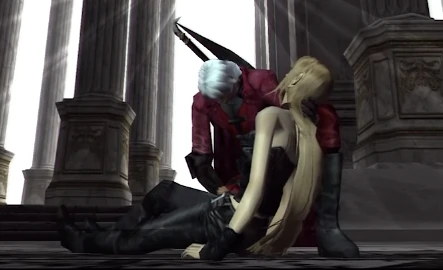
I should have been the one to fill your dark soul with liiiiiiiiiiight! |
| This article is a stub and is missing information. You can help the Devil May Cry wiki by expanding it. |
The Divina Commedia (Ita: "Divine Comedy") is an epic poem written by Dante Alighieri between 1308 and his death in 1321. The poem consists of three parts, Inferno (Ita: "Hell"), Purgatorio (Ita: "Purgatory"), and Paradiso (Ita: "Paradise"), and draws on medieval Christian theology and philosophy. It is heavily used as inspiration in the Devil May Cry series.
Allusions to Divine Comedy in the Devil May Cry series
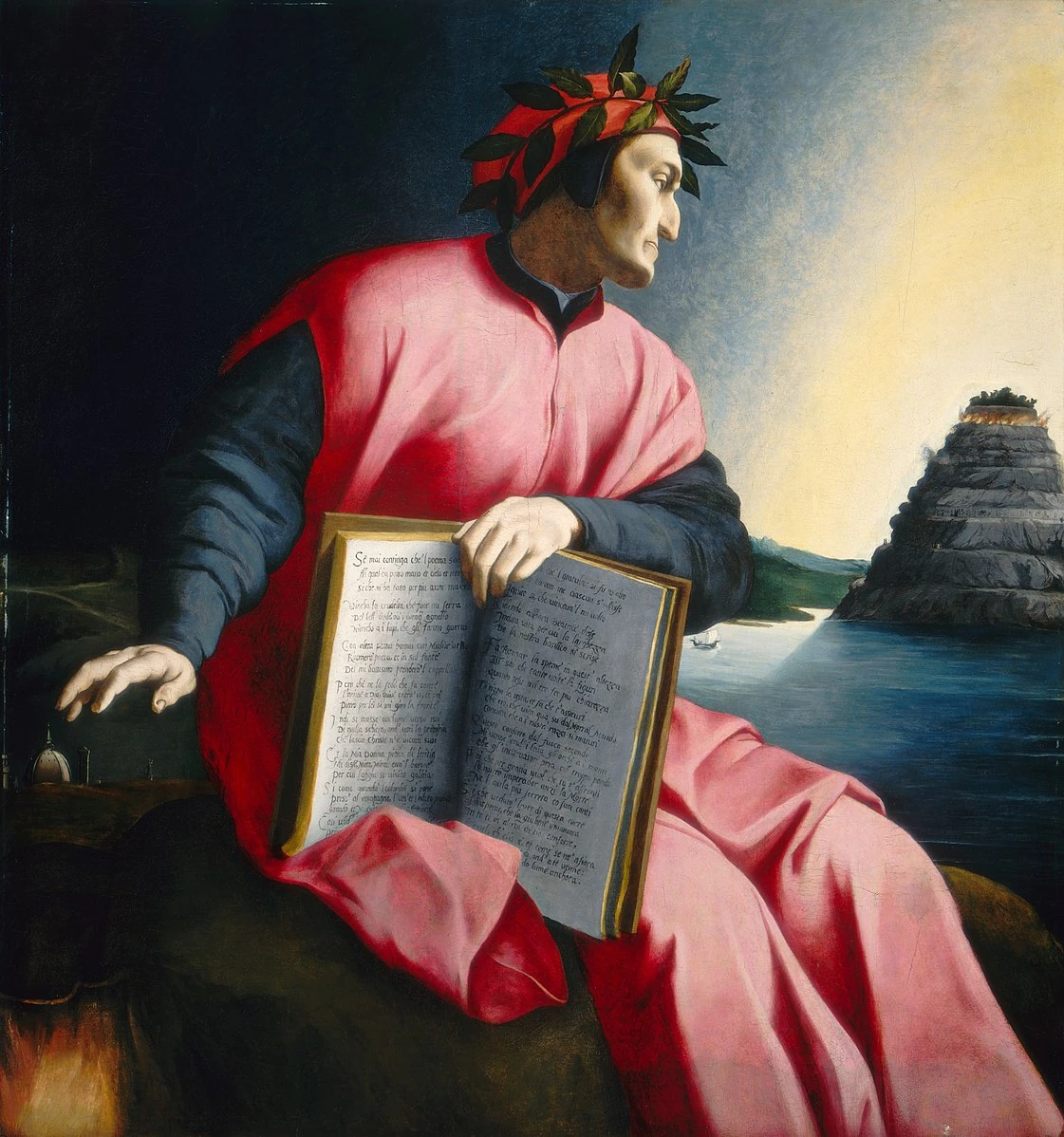

Dante Alighieri, author of Divine Comedy, is the namesake of Dante.
Devil May Cry
- Dante - The main character of the Devil May Cry series has his name derived from Dante Alighieri, the author and main character of the poem.[1]
- Vergil - The Roman poet Virgil is Dante's guide through Hell and Purgatory. He is a spirit who resides in the First Circle of Hell known as Limbo which is reserved for virtuous people who practiced religions other than Christianity. He represents human reason in Divine Comedy.[1]
- Trish - Dante Alighieri's idealized woman, Beatrice, guides Dante of the poem through Heaven. Trish is a shortened form of Beatrice. She represents divine love in Divine Comedy.[1]
- Nelo Angelo - Derived from the Fallen Angels located in the Vestibule of Hell in Dante's Inferno referred to as "Black Angels", who are depicted as the Angels sided with no-one in the Rebellion of Angels. The name Nelo Angelo is a mistranslation of "Nero Angelo" (Ita: "Black Angel").[1]
- Melancholy Soul - Derived from a phrase used to describe the damned souls located in the Vestibule of Hell in Dante's Inferno.
- Mundus - Mundus's depiction is similar to that of Satan in Divine Comedy. He is represented with three eyes similarly to Satan's depiction with three heads in the Inferno. His connections with Satan are also alluded to his pseudo-Angelic appearance but having a true demonic form reflecting traditional Fallen Angels, and having been banished and sealed within Hell.
Devil May Cry 2
- Lucia - A saint who came to help Dante in the Divine Comedy. Saint Lucia is the patron saint of the blind and those with eye-related issues which is referenced in Devil May Cry in which one of her eyes is covered. In Divine Comedy, she represents illuminating grace.
- Trismagia - In the Divine Comedy, Satan is depicted with three heads.
- Furiataurus - The minotaur appears in the Seventh Circle of Hell: Violence.
- Puia - Based off the Harpies, female half human and half bird creatures from Greek Mythology. Within the Divine Comedy, the Harpies are found within the Seventh Circle of Hell tormenting the suicides who have been entombed into oak trees.
- Argosax - Argosax's name is derived from Argos, an alternate spelling of Argus in Greek Mythology. Argus is briefly mentioned in The Divine Comedy (Purgatory, Canto XXIX, 94).
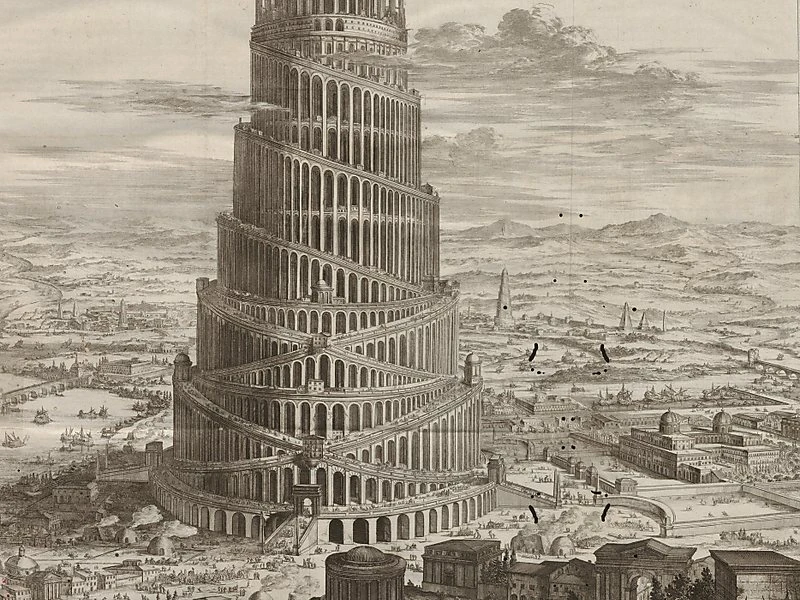

The Tower of Babel, as depicted by Athanasius Kircher
Devil May Cry 3
- Temen-ni-gru - Dante climbs the Mount of Purgatory to reach Heaven. The mountain consists of a bottom section, seven levels corresponding with the Seven Deadly Sins, and a topmost section akin to paradise on earth.
- This relationship is somewhat subverted in the game, as the top of the Temen-ni-gru leads to Hell.
- Vergil choosing to descend into the demon world after reaching the summit of Temen-ni-gru with his fight with Dante parallel Virgil's departure in Divine Comedy. After reaching the summit to Purgatory, Virgil is unable to come with Dante to Heaven as he can no longer serve as his guide due to being unsaved and thus departs back into his circle in Hell leaving Dante behind.
- The Temen-ni-gru can also be seen as an allegory to the Tower of Babel, which is also mentioned in Purgatorio.
- "Lady" (birth name: Mary) - Named after The Blessed Virgin Mary who appears in The Divine Comedy as a symbol of Divine Mercy to aid poet Dante Alighieri on his quest calling on St. Lucia and Beatrice to assist him. "Lady" is likely a reference to one of the virgin's other names, "Madonna" (Italian for "Lady").
- Geryon - In Inferno, the first part of The Divine Comedy, Geryon is a winged beast with the face of an "honest man" that lives between the Seventh and Eighth circles of Hell. Virgil and Dante ride him down into the Circle of Fraud known as Malebolge.
- Cerberus - In The Divine Comedy, Cerberus appears as the guardian of the Third Circle of Hell: Gluttony, which is beset by icy hail. This is likely referenced through the Cerberus's power to control ice within Devil May Cry 3.
- Arachne - A renowned weaver in Greek Mythology who was turned into a spider by the goddess Athena, Arachne is mentioned twice within Divine Comedy. In Purgatorio, Dante and Virgil encounter Arachne who is depicted as half-woman and half-spider and as a symbol of arrogance. She is also briefly mentioned in Inferno, to describe the design of Geryon's back. (Inferno, Canto XVII).
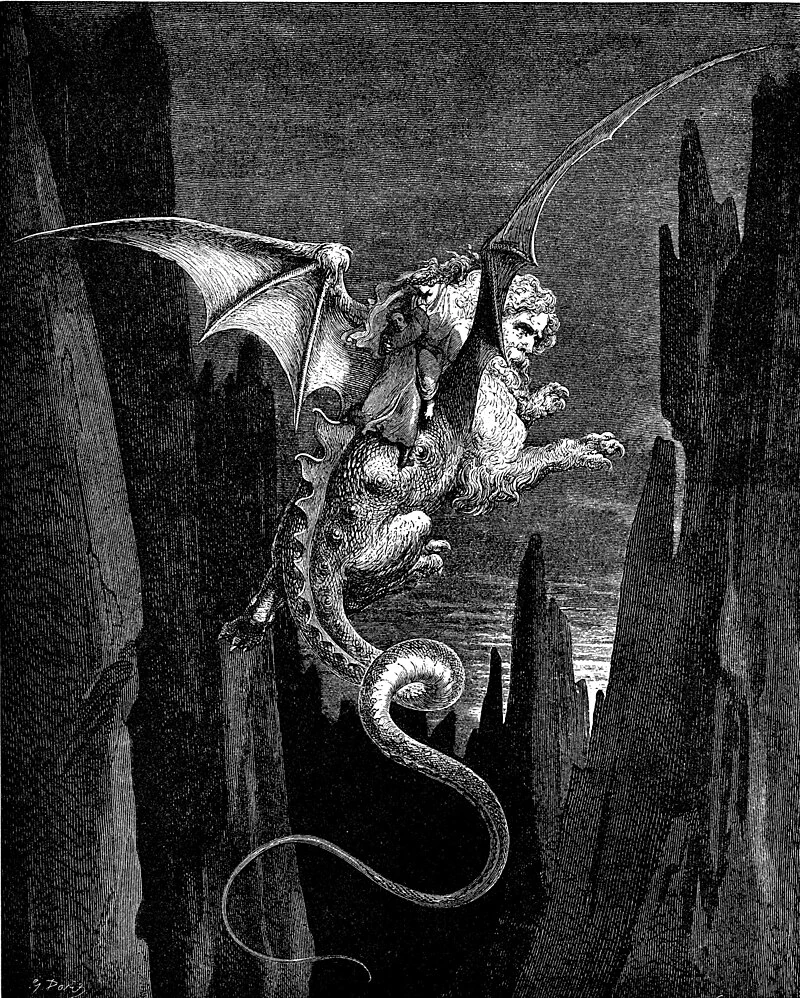

Dante's Geryon, depicted by Gustave Dore
Devil May Cry 4
- Fortuna - Named after Fortuna, the goddess of fortune in Roman mythology. In Divine Comedy, the Seventh Canto of Dante's Inferno includes a conversation between Dante and Vergil in which Vergil explains the divine role of Fortuna to Dante.
- "Abandon All Hope" - These words appear on the "Game Over" screen when the player dies and has no Gold Orbs remaining (or if the player selects "NO" if he or she has such). These words appear in the final line of the inscription on the Gates of Hell, "Abandon all hope, ye who enter here."
- Several mission titles of Devil May Cry 4 are taken from or related to Divine Comedy:
- La Porte de L'Enfer - is a monumental sculptural group work by French artist Auguste Rodin that depicts a scene from "The Inferno", the first section of The Divine Comedy by Dante Alighieri. The character Nero was originally going to be named after Auguste Rodin, its sculptor.
- The Ninth Circle - The name of the level is a reference to Dante Alighieri's Divine Comedy. In Inferno, the ninth and lowest circle of Hell is Cocytus, the Circle of Treachery, a large frozen lake reserved for sinners who betray their own, who Dante considered the worst of all sinners.
- Inferno - The mission title Inferno references both the "Inferno" portion of the Divine Comedy, as well as the flames of Berial.
- La Vita Nuova - The title of this last mission, "La Vita Nuova", is the name of a text by Dante Aligheri. It is a prosimetrum—a work containing both prose and poetic verse—about the subject of courtly and sacred love, and in particular Dante's own love for Beatrice Portinari.
- Lucifer - The title addressed to the devil in Christian tradition. Lucifer is found imprisoned in the lowest layer of Hell in Dante's Inferno. The weapon in Devil May Cry 4 has three blood red symbols on it possibly referencing Lucifer's depiction with three heads in Divine Comedy.
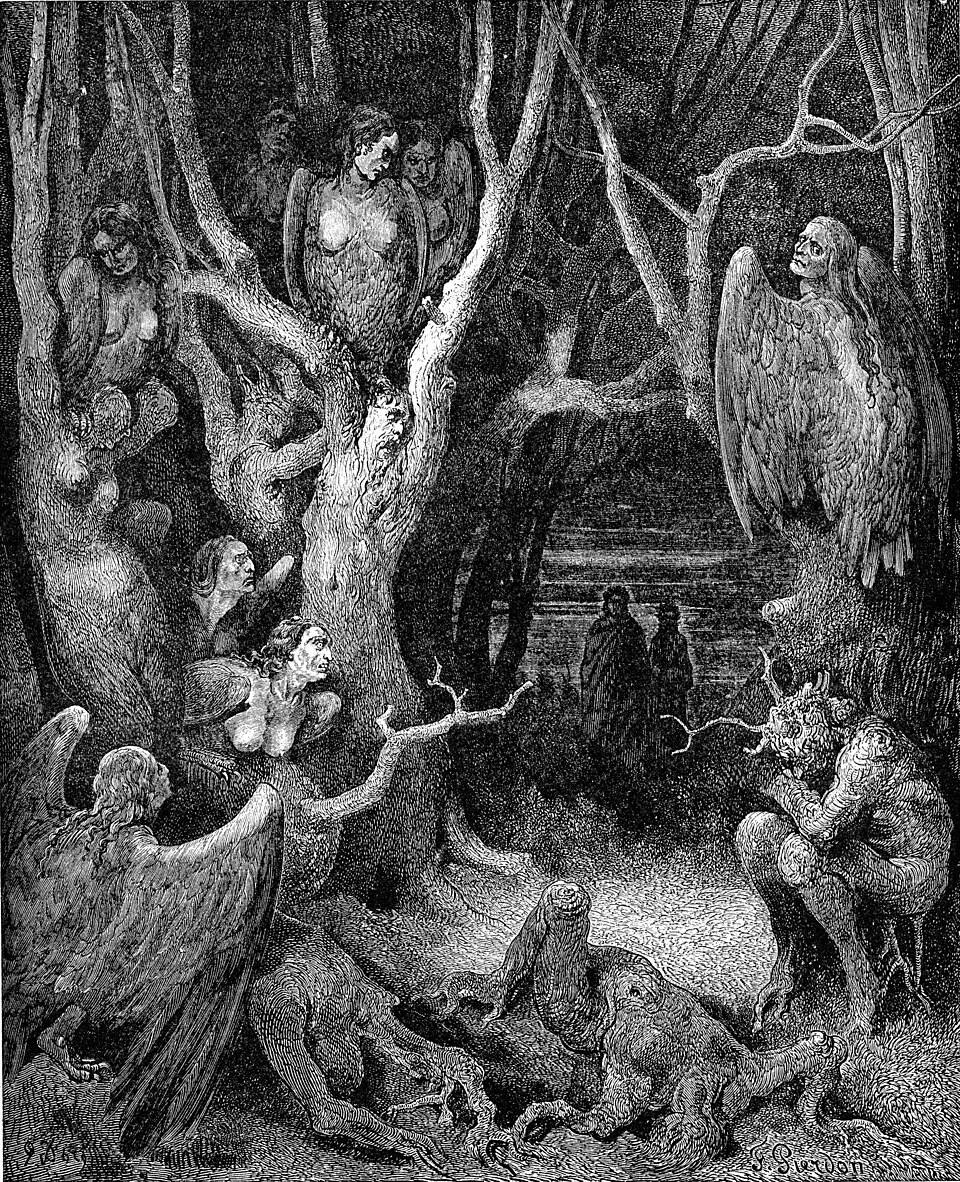

Harpies of Inferno, depicted by Gustave Dore
DmC: Devil May Cry
- Limbo - In Dante Alighieri's Divine Comedy, Limbo is the first circle of Hell that Dante and Virgil enter. Limbo is portrayed as being an area where virtuous pagans reside in. Although the virtuous pagans in Limbo are shown to be good-natured individuals compared to the heretics of the sixth circle of Hell, their lack of Christian faith prevented them from entering Paradiso.
- Harpy - Female half human and half bird creatures from Greek Mythology, in Divine Comedy, they are found within the Seventh Circle of Hell tormenting the suicides who have been entombed into oak trees.
- Stygian - A word referring to anything related to the River Styx of Greek mythology, located within the underworld. In Dante's Inferno, the River Styx is a river encountered by Dante in the Fifth Circle of Hell.
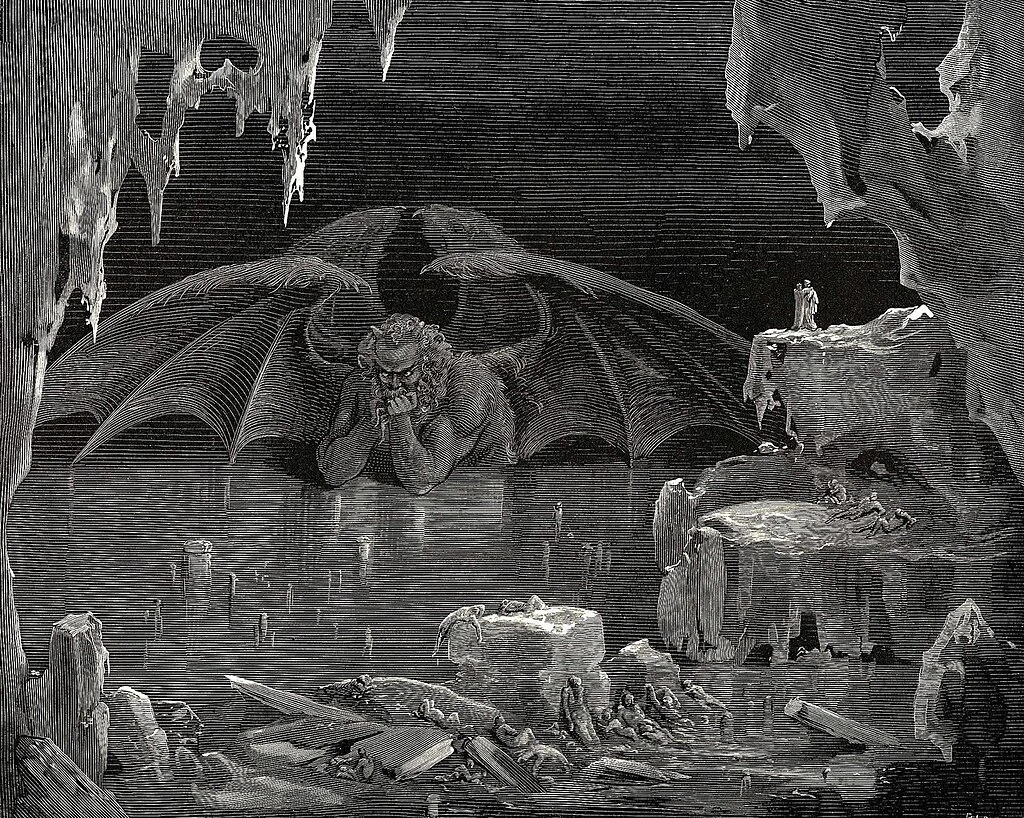

Dante's Cocytus, in which Lucifer is imprisoned.
Devil May Cry 5
- Hell Caina - In Dante's Inferno, Caina is a region located in the lowest layer of Hell named Cocytus reserved for traitors. The first round of Cocytus is Caina for the traitors of kindred. Named after Cain who killed his brother Abel in the Book of Genesis.
- Hell Antenora - Antenora is the second round of the lowest layer of Hell, Cocytus. The round is reserved for those who betrayed their country. Named after Antenor, a Trojan soldier mentioned in the Iliad who betrayed his city to Greece.
- Hell Judecca - Judecca is the fourth innermost round of Cocytus in Dante's Inferno, and is reserved for those who betrayed their masters and benefactors. Named after Judas Iscariot.
References
External links
- Wikipedia's article on Divine Comedy.